Shipping to all 50 U.S. states | Age Verified via AgeChecker.net | No Minors

Category: Uncategorized

  • Why People Microdose: A Positive Look at the Growing Interest in Psychedelic Microdosing

    Why People Microdose: A Positive Look at the Growing Interest in Psychedelic Microdosing

    Microdosing has become one of the most interesting parts of the modern psychedelic conversation.

    Instead of taking enough of a psychedelic to create a strong or overwhelming experience, people who microdose generally use a much smaller amount with the goal of staying present, functional, and connected to everyday life.

    For many people, the appeal is simple: they are looking for a subtle shift rather than a dramatic experience.

    Some are interested in a brighter mood. Others are looking for more creativity, focus, motivation, emotional openness, or a stronger connection to themselves and the world around them.

    While research is still developing, the growing number of personal reports and scientific studies has made microdosing an increasingly important area of psychedelic research.

    A More Positive Outlook

    One of the most common reasons people become interested in microdosing is the possibility of feeling more positive and engaged with everyday life.

    People often describe experiences such as:

    • Feeling more optimistic
    • Being more present
    • Feeling emotionally open
    • Appreciating everyday activities more
    • Feeling more connected to other people
    • Having greater motivation to take care of themselves

    For some, the change is not dramatic.

    It may simply feel like having a particularly good day.

    Researchers have also documented reports of improvements in mood, well-being, cognition, and social functioning among people who microdose, although scientists are continuing to study how consistent these effects are across different individuals.

    (more…)
  • Why Combining Psychedelics With Certain Medications Can Be Risky

    Why Combining Psychedelics With Certain Medications Can Be Risky

    Interest in magic mushrooms and psilocybin has grown dramatically in recent years. At the same time, many people interested in psychedelics take prescription medications for depression, anxiety, ADHD, bipolar disorder, pain, sleep, or other conditions.

    That creates an important question:

    What happens when psychedelics and prescription medications are combined?

    The answer isn’t always straightforward.

    Psilocybin primarily affects the brain’s serotonin system, particularly the 5-HT2A receptor. Many common medications influence serotonin or related brain systems as well. Combining substances that act on the same pathways can potentially change the effects of either substance, increase side effects, or create more serious risks.

    Research into psychedelic drug interactions is still developing. One major limitation is that many clinical trials historically excluded people taking certain psychiatric medications, meaning researchers have less direct evidence about these combinations than many people realize. (PubMed Central (PMC))

    Psilocybin and the Serotonin System

    Psilocybin itself is converted in the body into psilocin, the compound largely responsible for its psychedelic effects.

    Psilocin interacts strongly with serotonin receptors, especially the 5-HT2A receptor.

    Serotonin is involved in numerous functions, including:

    • Mood
    • Perception
    • Sleep
    • Anxiety
    • Cognition
    • Appetite
    • Sensory processing

    Many psychiatric medications also alter serotonin signaling.

    This doesn’t automatically mean that every serotonergic medication is dangerous when combined with psilocybin. The actual interaction depends on the medication, its mechanism, the individual, and other factors.

    What it does mean is that medication use should be taken seriously when discussing psychedelics.

    (more…)
  • Fresh vs. Dried Mushrooms: What’s the Difference?

    Fresh vs. Dried Mushrooms: What’s the Difference?

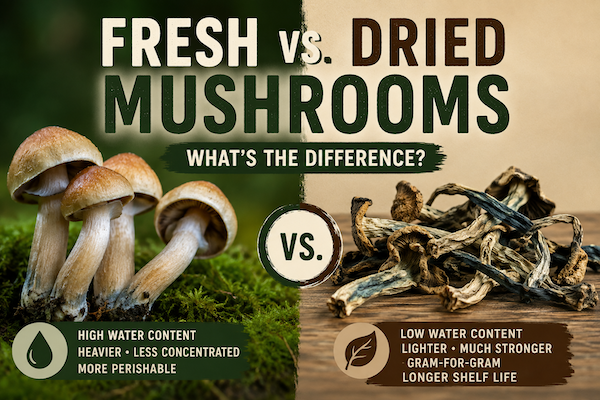
    Fresh and dried mushrooms may come from the exact same fruiting body, but once the water is removed, they become very different in terms of weight, texture, storage, and concentration.

    Fresh mushrooms are soft, flexible, and heavy with moisture. Dried mushrooms are lightweight, brittle, and much stronger gram-for-gram because most of their water has been removed.

    Understanding this difference is especially important when discussing active mushrooms.

    The Biggest Difference: Water

    Fresh mushrooms contain a large amount of water.

    A significant portion of a fresh mushroom’s weight comes from moisture rather than actual fungal material. When that mushroom is dried, most of the water is removed, leaving behind the concentrated mushroom material.

    This is why a large fresh mushroom can become surprisingly small after drying.

    The mushroom hasn’t necessarily lost most of its solid material—it has lost most of its water weight.

    Why Dried Mushrooms Are Much Stronger Gram-for-Gram

    One of the biggest differences between fresh and dried mushrooms is strength by weight.

    Fresh mushrooms contain a large amount of water. When that water is removed during drying, the remaining mushroom material becomes much more concentrated.

    As a result, dried mushrooms are much stronger gram-for-gram than fresh mushrooms.

    A gram of fresh mushroom contains a significant amount of water, while a gram of properly dried mushroom consists primarily of concentrated fungal material. The naturally occurring compounds in the mushroom are therefore concentrated into a much smaller overall weight.

    It’s important to understand that drying doesn’t create additional psilocybin or other active compounds. Instead, it removes water, meaning there is far more mushroom material per gram of dried product.

    This is why comparing equal weights of fresh and dried mushrooms can be misleading. One gram of fresh mushroom and one gram of dried mushroom do not represent the same amount of actual fungal material.

    The exact concentration can still vary substantially between individual mushrooms and genetic lines. Drying makes the material more concentrated by weight, but it doesn’t make every mushroom chemically identical.

    A Simple Example

    Imagine a fresh mushroom weighing 10 grams.

    Most of that weight may be water. After the mushroom is dried, it could weigh only a fraction of its original weight.

    The mushroom now looks smaller and weighs much less, but the remaining material is substantially more concentrated.

    This illustrates why one gram of dried mushroom can represent far more actual mushroom material than one gram of fresh mushroom.

    The same basic principle applies to dried fruit, herbs, and other foods: removing water reduces weight while concentrating the remaining solid material.

    (more…)
  • Why Does Mushroom Potency Vary So Much?

    Why Does Mushroom Potency Vary So Much?

    One of the most common questions surrounding active mushrooms is surprisingly difficult to answer: Why can two mushrooms that look almost identical have different levels of active compounds?

    The short answer is genetics, biology, and growing conditions.

    When people talk about mushroom potency, they are usually referring to the concentration of naturally occurring compounds such as psilocybin and psilocin in species that produce them. These compounds aren’t distributed perfectly evenly throughout every mushroom, and their concentrations can vary considerably from one specimen to another.

    Genetics Play a Major Role

    Just like people inherit different characteristics from their parents, mushrooms inherit genetic characteristics that influence how they grow and develop.

    Different Psilocybe cubensis cultivars can have different genetic backgrounds, and individual genetic lines within a named cultivar can also behave differently.

    This means that the name of a cultivar isn’t necessarily a guarantee of a particular chemical profile.

    Two mushrooms carrying the same cultivar name may have different genetics, particularly when comparing material from different sources or generations of selection.

    This is one reason mushroom genetics are such an interesting part of mycology.

    (more…)
  • Bluey Vuitton: What Makes This Cultivar Unique?

    Bluey Vuitton: What Makes This Cultivar Unique?

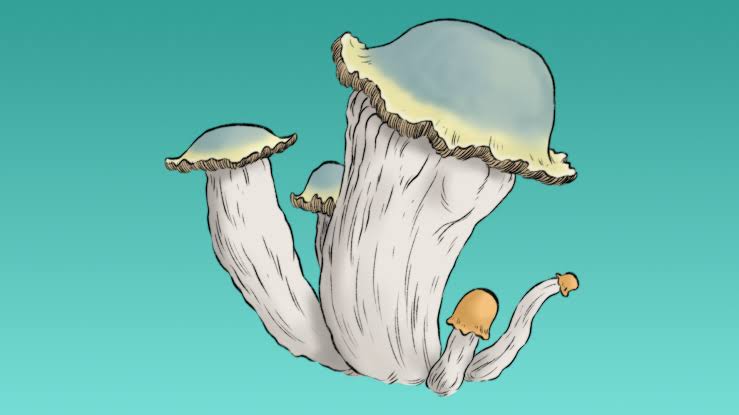
    Among the many cultivated varieties of Psilocybe cubensis, Bluey Vuitton has developed a reputation for its distinctive appearance, unusual genetics, and wide range of phenotypic expression. It is a modern hybrid cultivar rather than a naturally occurring species, and its reported lineage traces back to a cross between Panama and Melmac Penis Envy genetics.

    But what actually makes Bluey Vuitton different from other Psilocybe cubensis cultivars?

    A Modern Hybrid With an Interesting Lineage

    Bluey Vuitton is generally reported to have originated from a cross between the Panama cultivar and Melmac Penis Envy, with the hybrid commonly attributed to the mycologist known as Silly Cybin around 2014. Multiple mushroom-focused sources report this same basic lineage, although detailed historical documentation is limited and some of the stories surrounding its origins have become part of mushroom-community lore.

    That combination is interesting because Panama and Melmac Penis Envy represent very different branches of cultivated P. cubensis genetics. Bringing them together produced a lineage with a morphology that can look noticeably different from either parent.

    It is worth remembering that names such as “strain,” “variety,” “cultivar,” and “isolate” are often used somewhat interchangeably in mushroom communities. In a scientific context, Bluey Vuitton is best understood as a cultivated genetic lineage within the species Psilocybe cubensis.

    (more…)
  • Legal

    Legal

    The simplest way to understand where psilocybin stands legally is to compare it to cannabis a few years ago.

    Cannabis was once fully illegal. Then cities decriminalized it. Then states legalized it for medical use. Then for recreational use. Today, cannabis is legal in some form in the majority of U.S. states, yet it remains a Schedule I substance at the federal level. Psilocybin is following the same blueprint, just a few years behind.

    At the federal level, psilocybin is still classified as a Schedule I substance. However, the FDA granted psilocybin “breakthrough therapy” status in 2018 and 2019, opening the door for clinical research. In early 2026, the DEA significantly increased its production quotas for psilocybin and psilocin, signaling growing federal recognition of its research and therapeutic value.

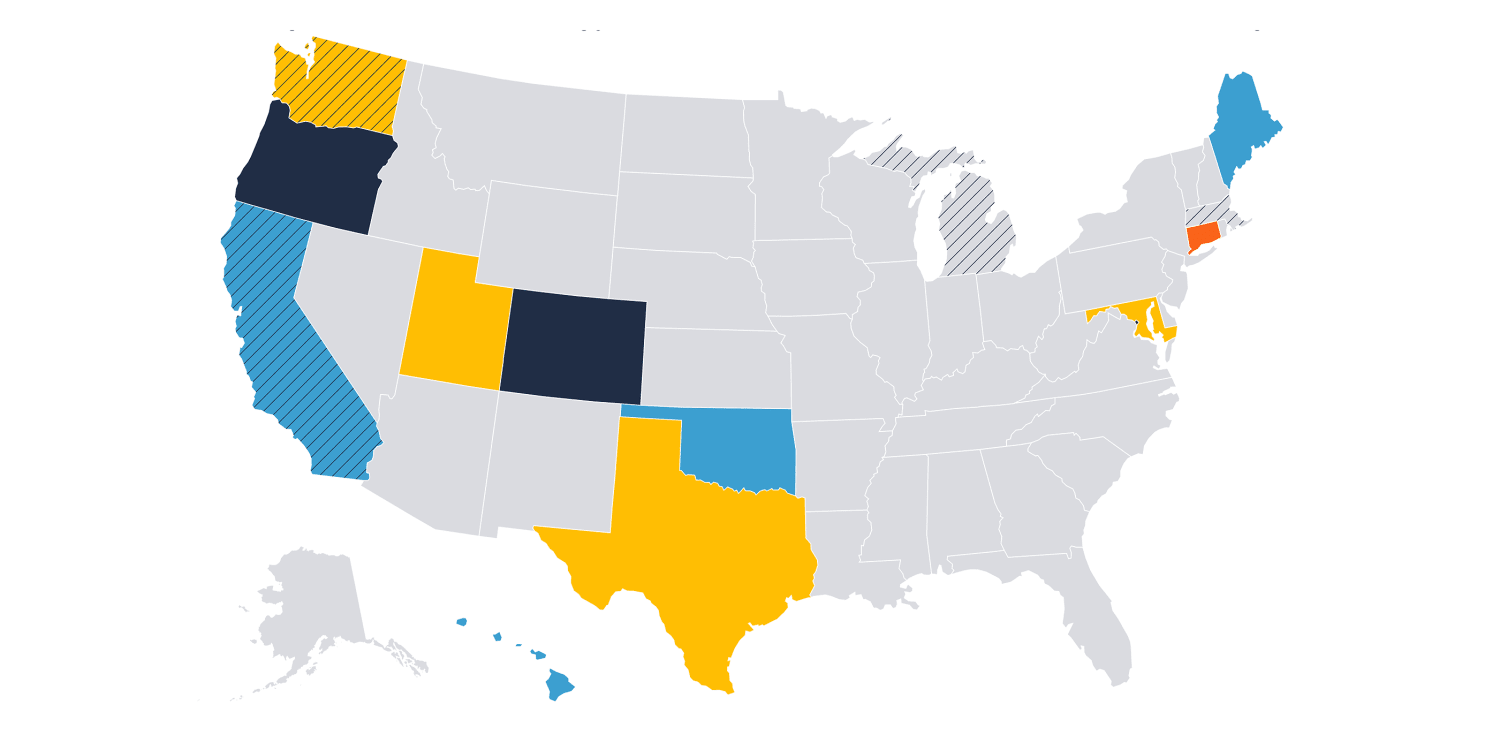
    Where psilocybin is legal or decriminalized

    States with legal frameworks for supervised psilocybin access:

    • Oregon — First state to legalize supervised psilocybin services (2020). Licensed service centers have been operating since mid-2023.
    • Colorado — Passed Proposition 122 in 2022, decriminalizing personal use and possession for adults 21+ and establishing a regulated framework for supervised “healing centers.” The state issued its first licenses for supervised use in March 2025.
    • New Mexico — Legalized a regulated medical psilocybin access pathway. Rules are being finalized, with availability expected by late 2026.

    States with research programs or pilot frameworks:

    • Washington — Authorized a limited psilocybin therapy pilot program through a public university. State penalties for personal possession of Schedule I substances were also reduced in 2021.
    • Texas — Approved $50 million in funding for FDA-supervised clinical trials of ibogaine for opioid use disorder and other conditions.
    • California — Governor Newsom signed AB 1103 into law, fast-tracking psychedelic research for PTSD and depression (effective January 2026).
    • New Jersey — Governor Murphy signed a law creating a $6 million pilot program placing psilocybin-assisted therapy research in three hospitals (January 2026).

    Cities and municipalities that have decriminalized psilocybin:

    Denver, CO (2019) — First city in the U.S. to decriminalize, Oakland, CA (2019), Santa Cruz, CA (2020), Washington, D.C. (2020), Ann Arbor, MI (2020), Somerville, MA (2021), Cambridge, MA (2021), Northampton, MA (2021), Easthampton, MA, Detroit, MI (2021), Seattle, WA (2021), Port Townsend, WA, Arcata, CA, Hazel Park, MI, Washtenaw County, MI

    States with active legislation (bills introduced or in progress):

    Alaska, Connecticut, Georgia, Hawaii, Illinois, Indiana, Iowa, Kansas, Kentucky, Maine, Maryland, Massachusetts, Minnesota, Nevada, New Hampshire, New York, North Carolina, Pennsylvania, Rhode Island, Utah, Vermont, Virginia, West Virginia

    These states have bills at various stages, from decriminalization proposals to regulated therapy programs and research funding. The pace is accelerating. In 2019, five psychedelic reform bills were introduced across the country. By 2025, that number exceeded three dozen in a single legislative session.

    Research projections based on the pace of cannabis reform estimate that a majority of U.S. states could legalize psilocybin in some form as early as 2028.

    MushAccess’s Position

    MushAccess operates from a decriminalized jurisdiction. All purchases are at the customer’s discretion, and we advise all customers to be aware of their local and state laws before ordering. Every customer is age verified, 21+ in the US to ensure no minors can access our products.

    This page is for informational purposes only and does not constitute legal advice. Psilocybin laws are changing rapidly. We encourage customers to verify current regulations in their jurisdiction.

  • A New Chapter for MushAccess.com

    A New Chapter for MushAccess.com

    If you’ve been with us through the years, you may recognize the people behind MushAccess.com. This new site comes from the same owners and team behind HexCart.org and MushroomsInBag.com—and it represents the next chapter of everything we’ve learned along the way.

    Over the years, we’ve had the opportunity to serve thousands of customers, answer countless questions, learn from the mushroom community, and build years of hands-on experience in the world of mushrooms, mycology, and natural products. Those experiences have helped shape what we’re building today.

    Why MushAccess?

    Our previous websites eventually faced challenges that were outside of our control. Our hosting and server providers were not willing to continue working with businesses in our particular industry, and our domains were negatively affected by the controversy surrounding natural plant- and mushroom-based products.

    Rather than let those setbacks stop us, we decided to start fresh.

    MushAccess.com is the result.

    This isn’t simply another website. It’s a new platform built from years of customer feedback, product knowledge, industry experience, and lessons learned from operating our previous sites.

    (more…)
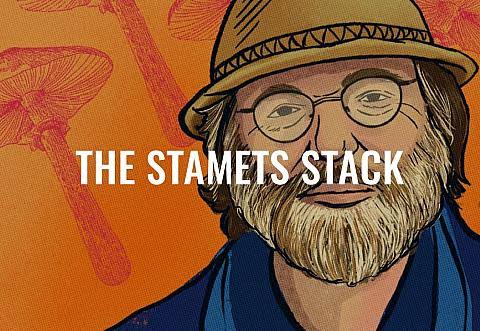
  • The Stamets Stack: A Modern Approach to Mushroom Microdosing

    The Stamets Stack: A Modern Approach to Mushroom Microdosing

    For generations, mushrooms have fascinated people with their unique place in nature, nutrition, culture, and science. Today, a new generation is exploring mushrooms in a different way: microdosing.

    One of the best-known approaches is the Stamets Stack—a combination traditionally associated with psilocybin mushrooms, Lion’s Mane, and niacin.

    But there’s an important distinction: microdosing doesn’t necessarily require the full stack. Some people choose to microdose with psilocybin-containing “magic mushrooms” alone, while others are interested in combining them with Lion’s Mane and niacin.

    What Is the Stamets Stack?

    The Stamets Stack is commonly associated with mycologist and mushroom advocate Paul Stamets.

    The traditional concept brings together three ingredients:

    • 🍄 Psilocybin mushrooms — the psychedelic component.
    • 🦁 Lion’s Mane — a non-psychedelic functional mushroom that has attracted interest for its potential neurological properties.
    • 💊 Niacin (vitamin B3) — an essential vitamin included in the traditional formulation.
    (more…)
  • How Safe Is Our Age Verification Process?

    How Safe Is Our Age Verification Process?

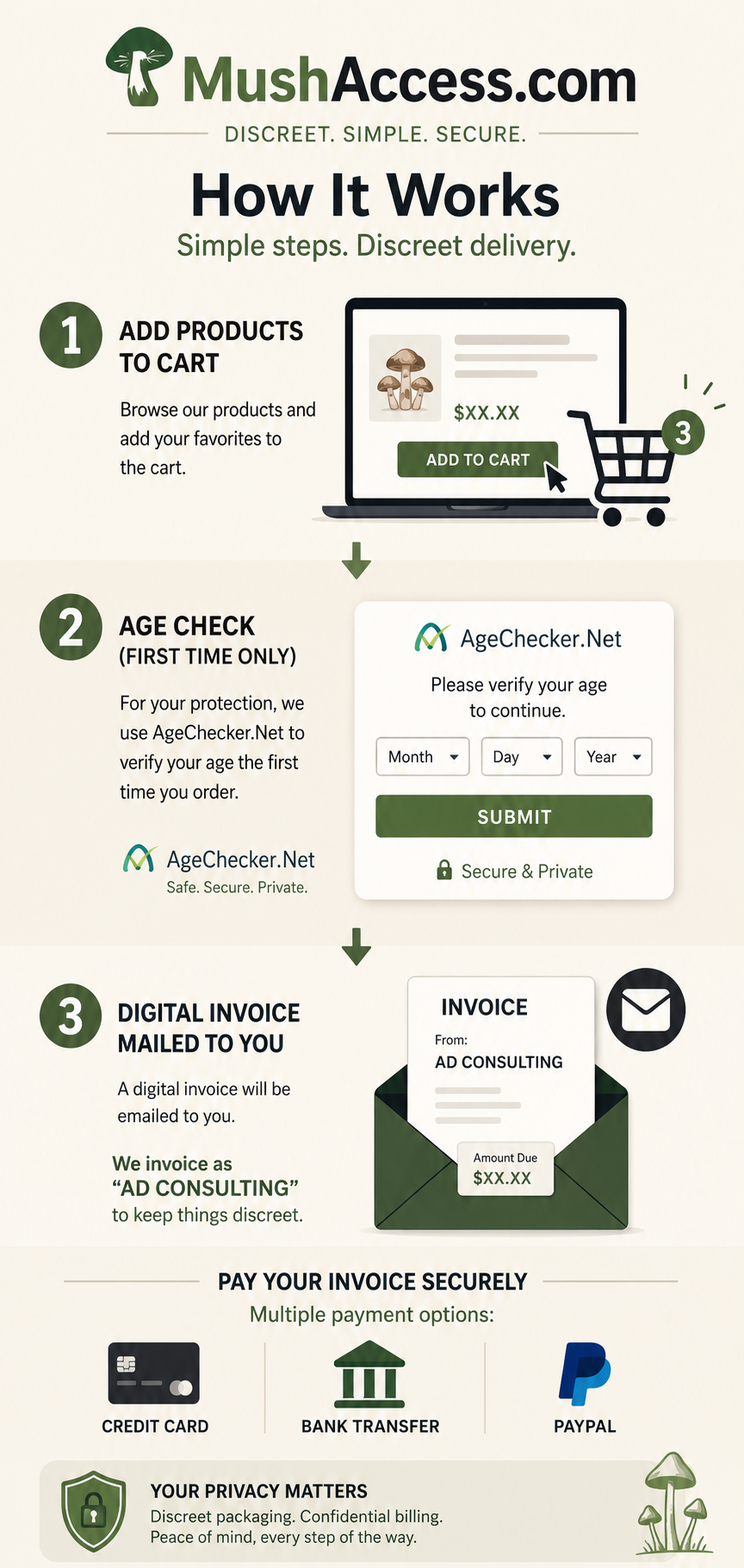
    At MushAccess, we understand that customers may have questions about privacy and security when an age-verification service asks for identification. Protecting customer information is extremely important to us, which is why we use AgeChecker.net as part of our age-verification process.

    Your Information and Identification

    AgeChecker.net may require identification to verify that a customer meets the required age. Importantly, the purpose of providing identification is to verify age—not to give MushAccess unnecessary access to sensitive personal information.

    According to the verification process we use, identification submitted for verification is handled through the age-verification system and is deleted after the verification process rather than being retained indefinitely.

    We also understand that customers may be understandably cautious about submitting ID online. That’s why we chose an established age-verification provider rather than attempting to collect and manually process sensitive identification ourselves.

    (more…)