
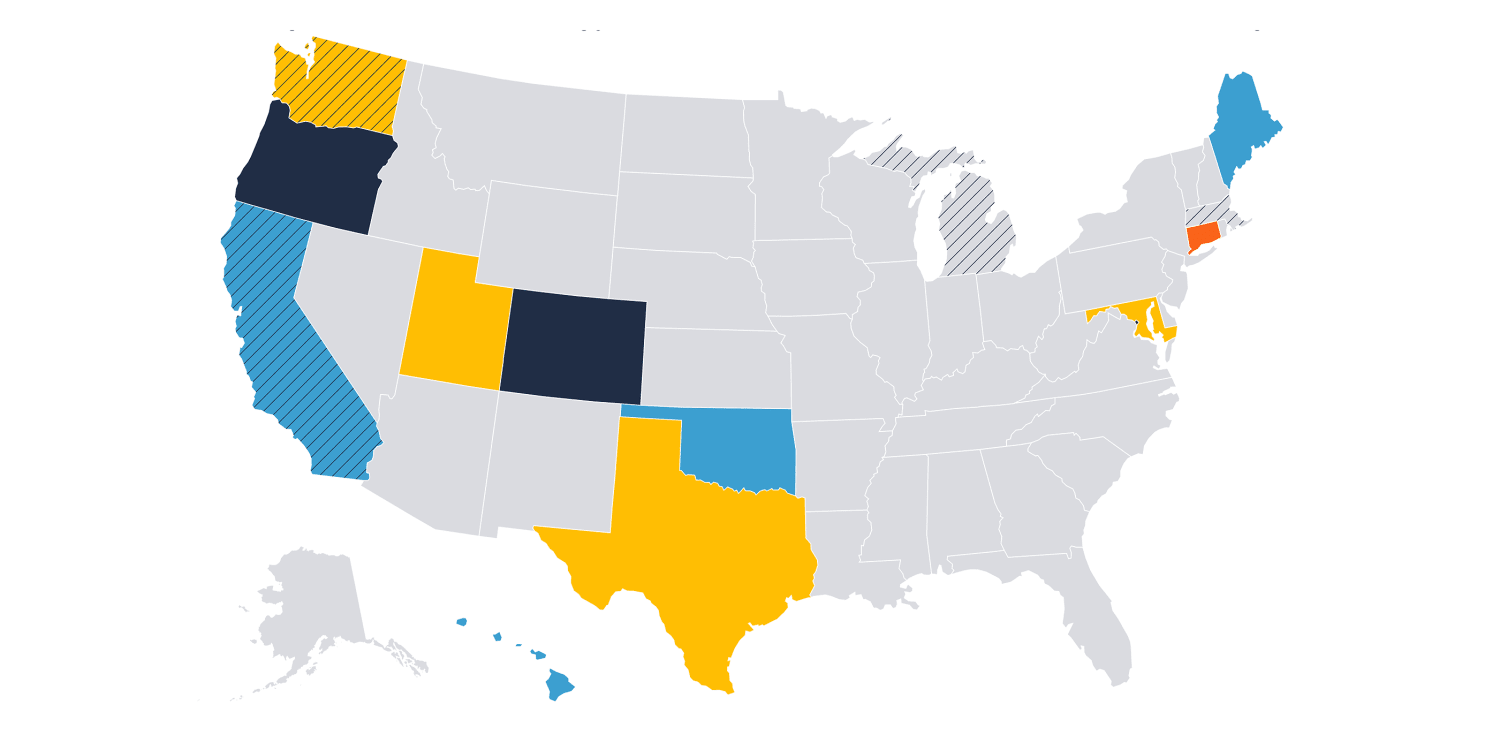
The simplest way to understand where psilocybin stands legally is to compare it to cannabis a few years ago.
Cannabis was once fully illegal. Then cities decriminalized it. Then states legalized it for medical use. Then for recreational use. Today, cannabis is legal in some form in the majority of U.S. states, yet it remains a Schedule I substance at the federal level. Psilocybin is following the same blueprint, just a few years behind.
At the federal level, psilocybin is still classified as a Schedule I substance. However, the FDA granted psilocybin “breakthrough therapy” status in 2018 and 2019, opening the door for clinical research. In early 2026, the DEA significantly increased its production quotas for psilocybin and psilocin, signaling growing federal recognition of its research and therapeutic value.
Where psilocybin is legal or decriminalized
States with legal frameworks for supervised psilocybin access:
- Oregon — First state to legalize supervised psilocybin services (2020). Licensed service centers have been operating since mid-2023.
- Colorado — Passed Proposition 122 in 2022, decriminalizing personal use and possession for adults 21+ and establishing a regulated framework for supervised “healing centers.” The state issued its first licenses for supervised use in March 2025.
- New Mexico — Legalized a regulated medical psilocybin access pathway. Rules are being finalized, with availability expected by late 2026.
States with research programs or pilot frameworks:
- Washington — Authorized a limited psilocybin therapy pilot program through a public university. State penalties for personal possession of Schedule I substances were also reduced in 2021.
- Texas — Approved $50 million in funding for FDA-supervised clinical trials of ibogaine for opioid use disorder and other conditions.
- California — Governor Newsom signed AB 1103 into law, fast-tracking psychedelic research for PTSD and depression (effective January 2026).
- New Jersey — Governor Murphy signed a law creating a $6 million pilot program placing psilocybin-assisted therapy research in three hospitals (January 2026).
Cities and municipalities that have decriminalized psilocybin:
Denver, CO (2019) — First city in the U.S. to decriminalize, Oakland, CA (2019), Santa Cruz, CA (2020), Washington, D.C. (2020), Ann Arbor, MI (2020), Somerville, MA (2021), Cambridge, MA (2021), Northampton, MA (2021), Easthampton, MA, Detroit, MI (2021), Seattle, WA (2021), Port Townsend, WA, Arcata, CA, Hazel Park, MI, Washtenaw County, MI
States with active legislation (bills introduced or in progress):
Alaska, Connecticut, Georgia, Hawaii, Illinois, Indiana, Iowa, Kansas, Kentucky, Maine, Maryland, Massachusetts, Minnesota, Nevada, New Hampshire, New York, North Carolina, Pennsylvania, Rhode Island, Utah, Vermont, Virginia, West Virginia
These states have bills at various stages, from decriminalization proposals to regulated therapy programs and research funding. The pace is accelerating. In 2019, five psychedelic reform bills were introduced across the country. By 2025, that number exceeded three dozen in a single legislative session.
Research projections based on the pace of cannabis reform estimate that a majority of U.S. states could legalize psilocybin in some form as early as 2028.
MushAccess’s Position
MushAccess operates from a decriminalized jurisdiction. All purchases are at the customer’s discretion, and we advise all customers to be aware of their local and state laws before ordering. Every customer is age verified, 21+ in the US to ensure no minors can access our products.
This page is for informational purposes only and does not constitute legal advice. Psilocybin laws are changing rapidly. We encourage customers to verify current regulations in their jurisdiction.

Leave a Reply