
If you’ve spent any time reading about psychedelic research, you’ve probably come across the term Default Mode Network, or DMN.
It sounds complicated, but the basic idea is surprisingly easy to understand.
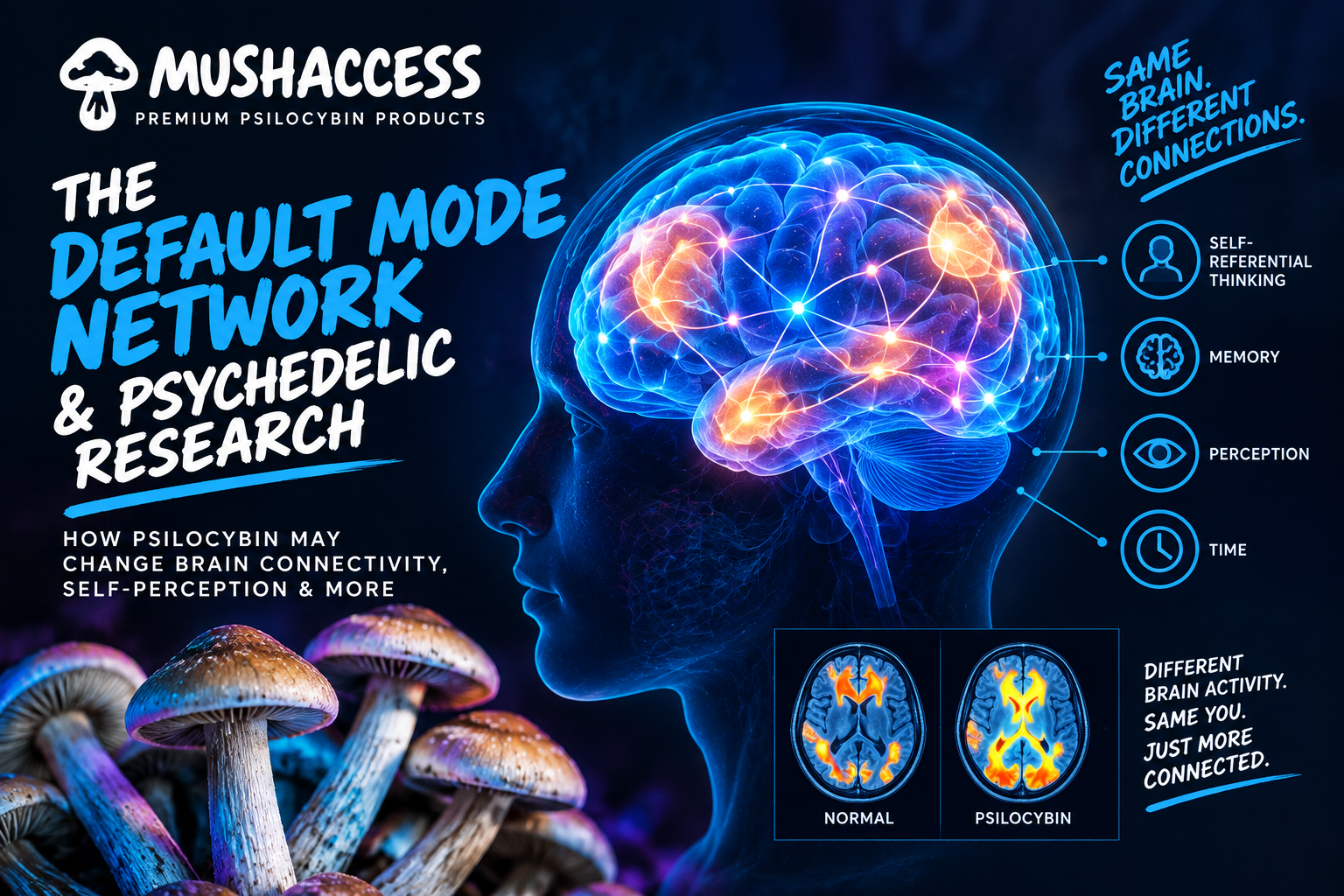
The DMN is a collection of interconnected brain regions involved in processes such as self-referential thinking, autobiographical memory, daydreaming, internal narratives, and thinking about the past and future.
Researchers have become particularly interested in the DMN because psychedelic experiences can involve noticeable changes in how people experience themselves, their thoughts, their surroundings, and their sense of time.
So what exactly is the DMN, and what does psychedelic research tell us about it?
What Is the Default Mode Network?
The Default Mode Network is a group of brain regions that tend to communicate with one another during certain types of internally focused mental activity.
Rather than being a single part of the brain, the DMN is better understood as a network.
Research has associated the network with several processes, including:
- Self-referential thinking
- Autobiographical memory
- Daydreaming
- Internal narrative
- Thinking about the past
- Imagining the future
In other words, the DMN is closely connected with the ongoing stream of thoughts that can make up our ordinary inner experience.
You aren’t necessarily aware of the network itself.
You’re aware of the thoughts, memories, plans, and mental narratives that emerge while your brain is operating.
Why Does the DMN Matter in Psychedelic Research?
One reason researchers are interested in the DMN is that psychedelic experiences can involve changes in the way people experience their sense of self.
Under ordinary circumstances, the brain maintains relatively familiar patterns of communication between different networks.
Psychedelic research has found that these patterns can change following psilocybin administration.
Brain-imaging studies have reported changes in DMN activity and functional connectivity.
Functional connectivity refers to how activity in different brain regions changes in relation to one another.
This doesn’t mean that the DMN simply switches off.
The reality is more complicated.
Researchers have observed changes in how brain networks communicate and organize their activity..
Psilocybin and Brain Connectivity
Psilocybin is converted by the body into psilocin, which interacts with serotonin receptors in the brain.
One receptor that is particularly important in psychedelic research is the 5-HT2A receptor.
These receptors are found in areas of the cerebral cortex involved in perception, cognition, attention, emotion, and self-referential processing.
When psilocin interacts with these receptors, brain signaling can change.
Researchers using brain-imaging techniques have investigated what happens to communication between different brain networks during these changes.
The result isn’t simply a brain that is “more active” or “less active.”
Instead, psychedelic states appear to involve changes in how different systems communicate with one another.
The DMN and the Sense of Self
One of the most interesting areas of psychedelic research involves the relationship between the DMN and our sense of self.
Your sense of identity isn’t generated by a single location in the brain.
It’s influenced by many processes, including memories, thoughts, expectations, emotions, and your internal narrative.
The DMN is involved in several of these processes.
Because psychedelic experiences can involve changes in self-referential thinking, researchers have investigated whether changes in DMN activity and connectivity might be related to these subjective effects.
This is an important distinction:
Brain-network changes are measurable, while the subjective experience itself is personal.
Researchers can observe changes in brain activity using imaging techniques, but connecting those measurements directly to a person’s individual experience is more complicated.
What Does “Disrupted Connectivity” Mean?
You’ve probably seen headlines suggesting that psychedelics “break down” the Default Mode Network.
That’s an oversimplification.
A better way to think about it is that psychedelic states can alter normal patterns of connectivity and communication between brain networks.
The brain isn’t simply being switched off.
Instead, the organization of activity can become different from ordinary waking consciousness.
This may help explain why psychedelic experiences can involve unusual changes in:
- Thought patterns
- Perception
- Emotional processing
- Sense of self
- Time perception
- Internal narratives
However, researchers are still working to determine exactly how these different observations fit together.
The Default Mode Network Isn’t the Whole Story
It’s tempting to look at the DMN and assume that it explains everything about psychedelic experiences.
It doesn’t.
The brain contains many interacting networks and neurotransmitter systems.
Psilocybin-related research also examines serotonin signaling, glutamate, functional connectivity, perception, emotional processing, and other aspects of brain function.
The DMN is therefore one piece of a much larger puzzle.
This is important because psychedelic experiences are extremely complex.
A single brain network cannot fully explain everything a person may think, feel, perceive, or experience during a psychedelic state.
What Researchers Are Still Trying to Understand
One of the biggest questions in psychedelic neuroscience is how changes in brain connectivity relate to changes in consciousness and subjective experience.
Researchers are continuing to investigate questions such as:
- How does psilocybin change communication between brain networks?
- What role does the DMN play in changes to self-referential thinking?
- How do changes in connectivity relate to subjective psychedelic effects?
- How does serotonin signaling contribute to these changes?
- Which brain changes are temporary?
- Which changes, if any, could be associated with longer-term effects?
These questions are part of an active area of scientific research.
It’s also important to distinguish between observing a biological effect and proving a specific outcome.
For example, evidence that a psychedelic changes brain-network connectivity does not automatically demonstrate that it will produce a particular psychological or mental-health outcome.
Why This Research Matters
The Default Mode Network gives researchers one way to investigate something that is otherwise difficult to measure:
What happens to the brain when our ordinary sense of consciousness changes?
Modern brain-imaging techniques allow researchers to examine changes in communication between brain regions and networks while also collecting information about people’s subjective experiences.
That combination is helping scientists develop a more detailed picture of psychedelic states.
But there is still plenty we don’t know.
The science is developing, and individual studies should be understood as pieces of a larger research picture rather than definitive explanations of consciousness.
The Bigger Picture
The DMN is one of the most interesting networks researchers study when trying to understand psychedelic experiences.
It is associated with self-referential thinking, memory, internal narratives, and thinking about the past and future.
Research involving psilocybin has found acute changes in DMN activity and connectivity, along with broader changes in communication between brain networks.
The important takeaway isn’t that psychedelics simply “turn off” the DMN.
It’s that psychedelic states can change the way brain networks communicate and organize information.
Understanding what those changes mean—and how they relate to subjective experience—is an ongoing scientific question.
Quick Recap
DMN = a network involved in self-referential thought, memory, internal narratives, and related processes.
Functional connectivity = a way researchers describe relationships in activity between different brain regions or networks.
Psilocybin → Psilocin = the body converts psilocybin into psilocin, which interacts with serotonin receptors including 5-HT2A.
Psychedelic research = studies suggest changes in brain-network activity and connectivity during psychedelic states.
The big question = how do measurable changes in brain networks relate to changes in consciousness and subjective experience?
The research continues.
Stay curious. Stay informed. Keep learning.
Primary research
- Carhart-Harris et al. (2012) — PNAS
Neural correlates of the psychedelic state as determined by fMRI studies with psilocybin
Early human fMRI work examining psilocybin-associated changes in brain activity, including decreases involving the anterior and posterior cingulate cortex.
Read the PNAS paper - Roseman et al. (2014) — Frontiers in Human Neuroscience
The effects of psilocybin and MDMA on between-network resting state functional connectivity in healthy volunteers
Found increased between-network functional connectivity under psilocybin, suggesting reduced differentiation between normally distinct networks.
Read the PubMed record - Lebedev et al. (2015) — Human Brain Mapping
Finding the self by losing the self: Neural correlates of ego-dissolution under psilocybin
Examined the relationship between subjective ego-dissolution and changes in functional connectivity.
Read the PubMed record - Siegel et al. (2024) — Nature
Psilocybin desynchronizes the human brain
A newer longitudinal imaging study reporting widespread changes in functional connectivity, with particularly strong effects involving the DMN; some hippocampus-DMN connectivity changes persisted for weeks in the study.
Read the Nature paper
DMN background/review sources
- Buckner & DiNicola (2019) — Nature Reviews Neuroscience
The brain’s default network: updated anatomy, physiology and evolving insights
Useful for explaining what the DMN is and its relationship to memory, future thinking, and internally oriented cognition. - Yeshurun, Nguyen & Hasson (2021) — Nature Reviews Neuroscience
The default mode network: where the idiosyncratic self meets the shared social world
Particularly useful for the article’s discussion of the DMN, self-related processing, memories, and future-oriented thought. - Smallwood et al. (2021) — Nature Reviews Neuroscience
The default mode network in cognition: a topographical perspective
Good broader overview of DMN anatomy and its involvement in complex cognition.
Recommended products
-
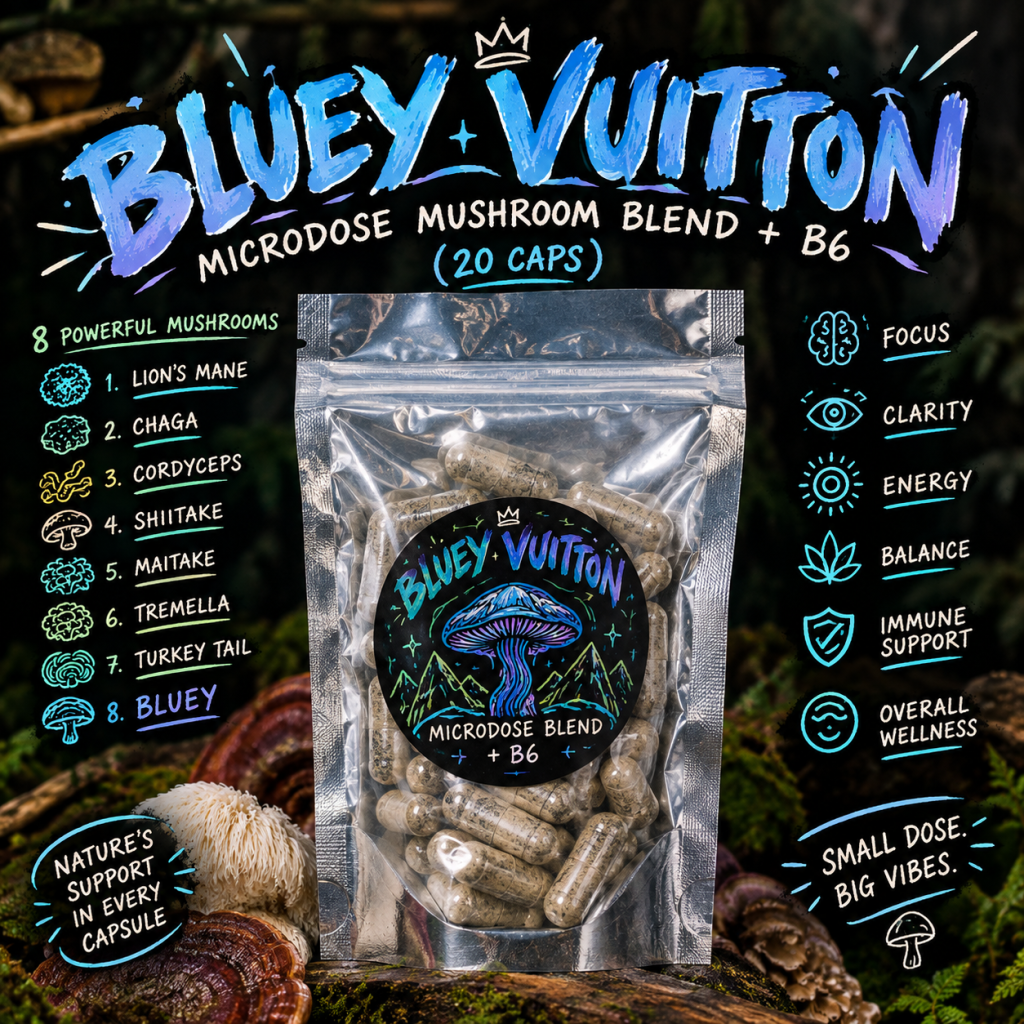
BLUEY VUITTON — MICRODOSE MUSHROOM BLEND + B6 (20 caps)
Original price was: $90.00.$75.00Current price is: $75.00. -
Bluey Vuitton (4 Gram) MushAccess Chocolate Bar
Original price was: $80.00.$50.00Current price is: $50.00. -
Bluey Vuitton (40 Gram) Chocolate Bars – 10 Pack
Original price was: $500.00.$400.00Current price is: $400.00. -
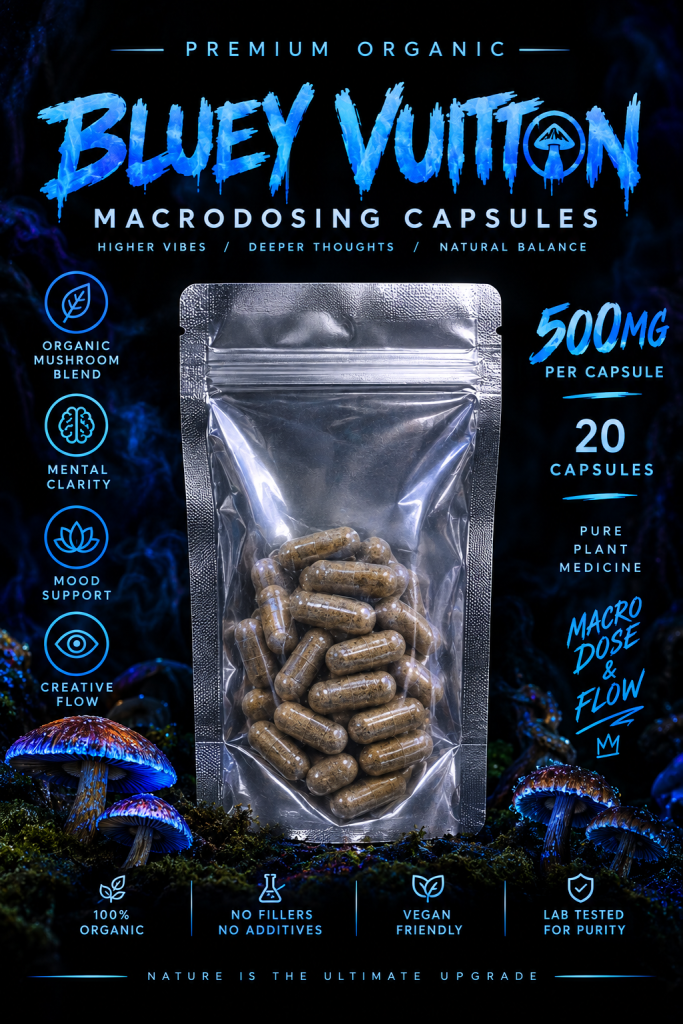
Bluey Vuitton 500mg Organic Macrodosing Capsules (20 Caps)
Original price was: $120.00.$90.00Current price is: $90.00. -
Dried Bluey Vuitton 1/8th (4 Grams)
Original price was: $80.00.$60.00Current price is: $60.00. -
Dried Bluey Vuitton Ounce (30 Grams)
Original price was: $250.00.$200.00Current price is: $200.00. -
House Formula Powder (1 Ounce)
Original price was: $150.00.$100.00Current price is: $100.00.






Leave a Reply