
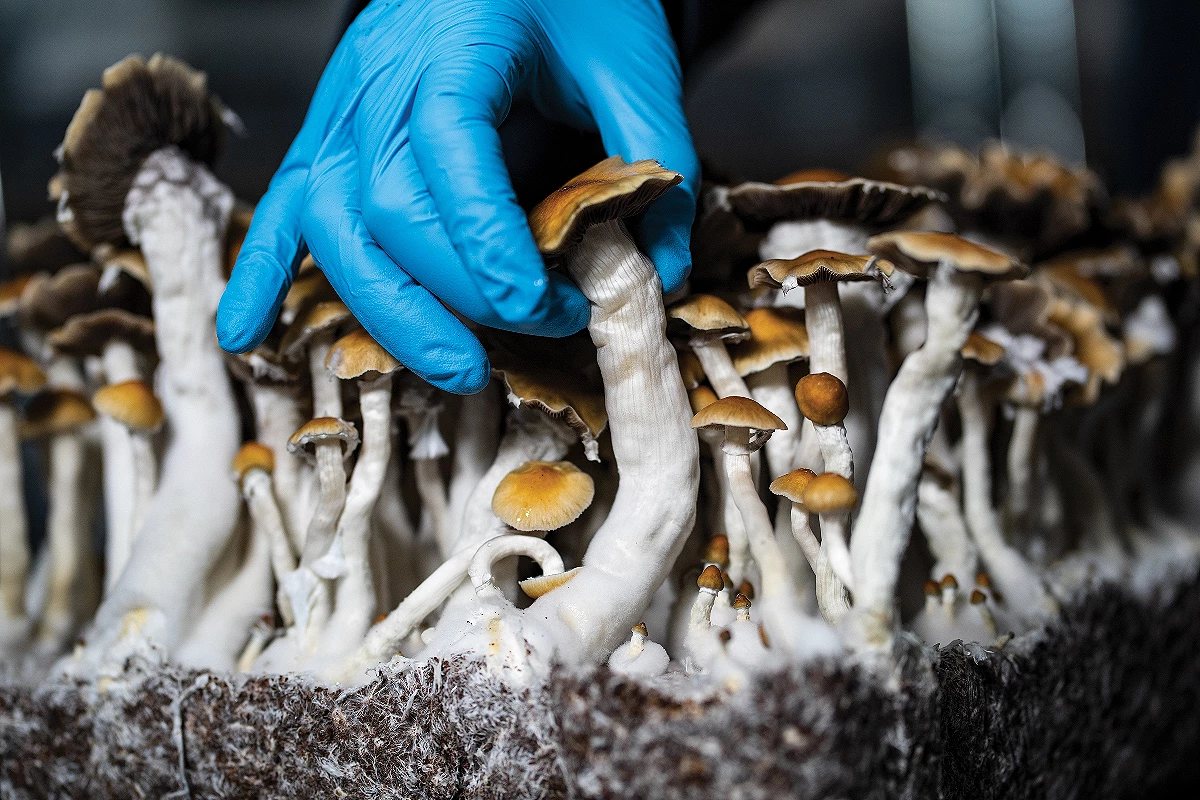
If you’re new to psychedelic mushrooms, the names can get confusing pretty quickly.
Bluey Vuitton. Penis Envy. Melmac. Panama. Golden Teacher. B+.
Then there are terms like psilocybin, psilocin, tryptamines, potency, genetics, and alkaloids.
So what does it all actually mean?
This guide breaks down the basics of mushroom varieties and, more importantly, explains what the active compounds do in the body and brain.
Species vs. Variety
Let’s start with the basics.
Species is the biological classification of the mushroom.
Variety or genetic line describes a particular set of genetics within that species.
For example, Psilocybe cubensis is a species that includes many varieties commonly discussed in the mushroom community.
You may come across names such as:
- Panama
- Golden Teacher
- B+
- Penis Envy
- Melmac
- Bluey Vuitton
These names don’t necessarily mean you’re dealing with completely different species. In many cases, they describe different genetic lines of the same species.
Genetics can influence appearance, growth characteristics, size, shape, and the concentration and balance of naturally occurring compounds.
What Makes a Mushroom “Active”?
When people talk about active mushrooms, they’re generally referring to mushrooms containing psychedelic compounds such as psilocybin and psilocin.
Psilocybin is the best-known compound, but it’s important to understand what happens after it enters the body.
Psilocybin is converted into psilocin, its primary psychoactive metabolite. Psilocin can cross the blood-brain barrier and interact with several serotonin receptors.
This is where the experience begins.
Psilocybin → Psilocin
Think of psilocybin as the starting point.
After ingestion, the body rapidly converts psilocybin into psilocin through a process called dephosphorylation. Psilocin is the compound that produces most of the psychedelic effects in the central nervous system.
A simplified way to look at it is:
Mushroom → Psilocybin → Psilocin → Serotonin receptors → Changes in brain signaling
Psilocin has a chemical structure similar to serotonin, which allows it to interact with serotonin receptors in the brain.
The 5-HT2A Receptor
The most important receptor to understand when discussing psilocybin is 5-HT2A.
Psilocin acts as a partial agonist at this receptor, and evidence indicates that 5-HT2A activation is central to the psychedelic effects of psilocybin. Studies using 5-HT2A-blocking drugs have shown substantial reductions in the subjective psychedelic effects.
5-HT2A receptors are particularly common in areas of the cerebral cortex involved in:
- Perception
- Attention
- Cognition
- Emotion
- Self-referential thinking
When psilocin interacts with these receptors, normal patterns of brain signaling can change.
That can contribute to changes in perception, thought patterns, sensory processing, emotions, and the sense of self.
What Happens in the Brain?
One of the interesting things researchers have observed is that psilocybin doesn’t simply “turn the brain up” or “turn the brain down.”
It changes how different brain networks communicate.
Brain-imaging studies have found changes in functional connectivity following psilocybin administration, including changes involving networks associated with self-referential processing and perception.
One network researchers often discuss is the Default Mode Network (DMN).
The DMN is involved in things such as:
- Self-referential thinking
- Autobiographical memory
- Daydreaming
- Internal narrative
- Thinking about the past and future
Research has found acute changes in DMN activity and connectivity following psilocybin administration.
This is one possible reason psychedelic experiences can feel different from ordinary waking consciousness.
Psilocybin & Glutamate
Serotonin isn’t the only neurotransmitter system researchers are interested in.
Activation of 5-HT2A receptors can influence glutamate signaling, particularly in cortical circuits.
Glutamate is one of the brain’s primary excitatory neurotransmitters and plays important roles in learning, memory, and communication between neurons. Research suggests that psilocybin-related changes in glutamate signaling may contribute to changes in neural activity and plasticity.
This is one reason researchers are studying psilocybin’s possible relationship with neuroplasticity.
What Is Neuroplasticity?
Neuroplasticity is the brain’s ability to change and adapt.
Your brain isn’t a static structure. Connections between neurons can strengthen, weaken, form, or reorganize throughout life.
Research into psychedelics has found evidence that psychedelic compounds can influence processes associated with neuronal plasticity. NIH-supported research has also investigated how compounds acting at 5-HT2A receptors may promote the growth of structures involved in connections between neurons.
It’s important to separate this biological research from marketing claims.
Evidence that a compound affects neuroplasticity does not automatically mean that taking a mushroom will produce a particular mental-health outcome.
The science is still developing.
What Are the Other Active Compounds?
Psilocybin and psilocin get most of the attention, but psychedelic mushrooms contain other naturally occurring compounds as well.
Researchers have identified additional tryptamine-related compounds and metabolites, but their individual roles are much less understood than psilocybin and psilocin.
Some compounds that appear in discussions of Psilocybe mushrooms include:
- Psilocybin
- Psilocin
- Baeocystin
- Norbaeocystin
- Aeruginascin
The important thing to remember is that the presence of a compound doesn’t necessarily mean we fully understand what it does in humans.
Psilocybin and psilocin have received substantially more scientific attention than many of the minor compounds.
Why Genetics Matter
This brings us back to mushroom varieties.
Different genetic lines can have different chemical profiles.
That means the name of a variety can tell you something about its genetics, but the name alone isn’t a precise measurement of potency.
Potency can vary between:
- Genetic lines
- Individual mushrooms
- Flushes
- Growing conditions
- Harvest maturity
- Drying methods
- Storage conditions
Even mushrooms from the same grow can vary.
That’s why experienced mushroom researchers and cultivators tend to look at the whole picture rather than relying only on a strain name.
Bluey Vuitton
Bluey Vuitton is one example of a hybrid genetic line discussed in the mushroom community.
It is associated with Panama and Melmac Penis Envy (PE) genetics.
That makes it interesting from a genetics perspective because it combines lineage from two different genetic backgrounds.
Like other mushroom varieties, its appearance and chemistry can vary depending on genetics and cultivation conditions.
The name itself shouldn’t be treated as a guarantee of a specific potency level.
Why Some Mushrooms Are Considered More Potent
You’ll often hear certain varieties described as “strong” or “high potency.”
There can be real genetic differences behind those reputations, but it’s important to understand that potency isn’t determined by the name alone.
The concentration of active compounds can vary considerably.
For that reason, statements like:
“This variety is exactly twice as strong.”
should be treated cautiously unless there is actual analytical testing behind the claim.
Microdosing vs. Larger Doses
The amount consumed can dramatically change the experience.
A microdose generally refers to an amount intended to produce little or no obvious psychedelic intoxication.
A larger dose can produce much more noticeable changes in:
- Visual perception
- Sensory processing
- Time perception
- Emotional intensity
- Thought patterns
- Sense of self
At sufficiently high exposure, psilocybin can produce a full psychedelic experience.
This is why the terms microdosing and macrodosing describe very different experiences even though the underlying active compound is the same.
What About Microdosing?
Microdosing has become popular because some people report subtle changes in areas such as:
- Focus
- Creativity
- Mood
- Energy
- Mindfulness
However, research on microdosing is more limited than research on full-dose psychedelic experiences, and placebo-controlled studies have produced mixed findings.
That makes it especially important to distinguish personal reports from established scientific findings.
The interesting question isn’t simply whether people report benefits.
It’s which effects can be reliably demonstrated, for whom, under what conditions, and at what exposure levels.
That’s an area researchers continue to investigate.
Why Set & Setting Still Matter
The effects of psychedelic mushrooms aren’t determined by chemistry alone.
A person’s surroundings, expectations, mood, previous experience, and physical environment can all influence how an experience unfolds.
This is often summarized by the phrase:
Set = your mindset.
Setting = your environment.
Two people can consume the same substance and have very different experiences.
That’s one reason responsible psychedelic education needs to include more than genetics and potency.
What Happens to the Body?
Psychedelics affect more than perception.
Psilocybin can produce physical effects including changes in:
- Heart rate
- Blood pressure
- Body temperature
- Nausea
- Dizziness
- Muscle tension
- Pupil size
Headache and nausea are among the commonly reported short-term adverse effects in clinical research.
The intensity of physical and psychological effects can vary with exposure, individual physiology, surroundings, and other factors.
The Bigger Picture
The fascinating thing about psychedelic mushrooms is that there isn’t just one story.
There is the genetics.
There is the chemistry.
There is the brain.
And there is the experience.
A variety name tells you something about the genetic history of a mushroom, but it doesn’t tell you everything about its chemistry or what an individual person will experience.
Understanding the difference between those things is one of the best places to start.
Quick Recap
Species = the biological group.
Variety/genetics = a particular genetic line.
Psilocybin = the primary psychedelic precursor found in many psychedelic mushrooms.
Psilocin = the primary psychoactive metabolite produced from psilocybin.
5-HT2A = the serotonin receptor strongly associated with psilocybin’s psychedelic effects.
Neuroplasticity = the brain’s ability to change and reorganize.
Potency = the concentration and effective amount of active compounds, which can vary considerably.
Set & setting = mindset and environment that can influence the experience.
Keep Learning
We’re continuing to build the MushAccess blog with guides covering mushroom genetics, microdosing, macrodosing, functional mushrooms, active compounds, and psychedelic education.
MushAccess.com
Stay curious. Stay informed. Keep growing.


Leave a Reply